
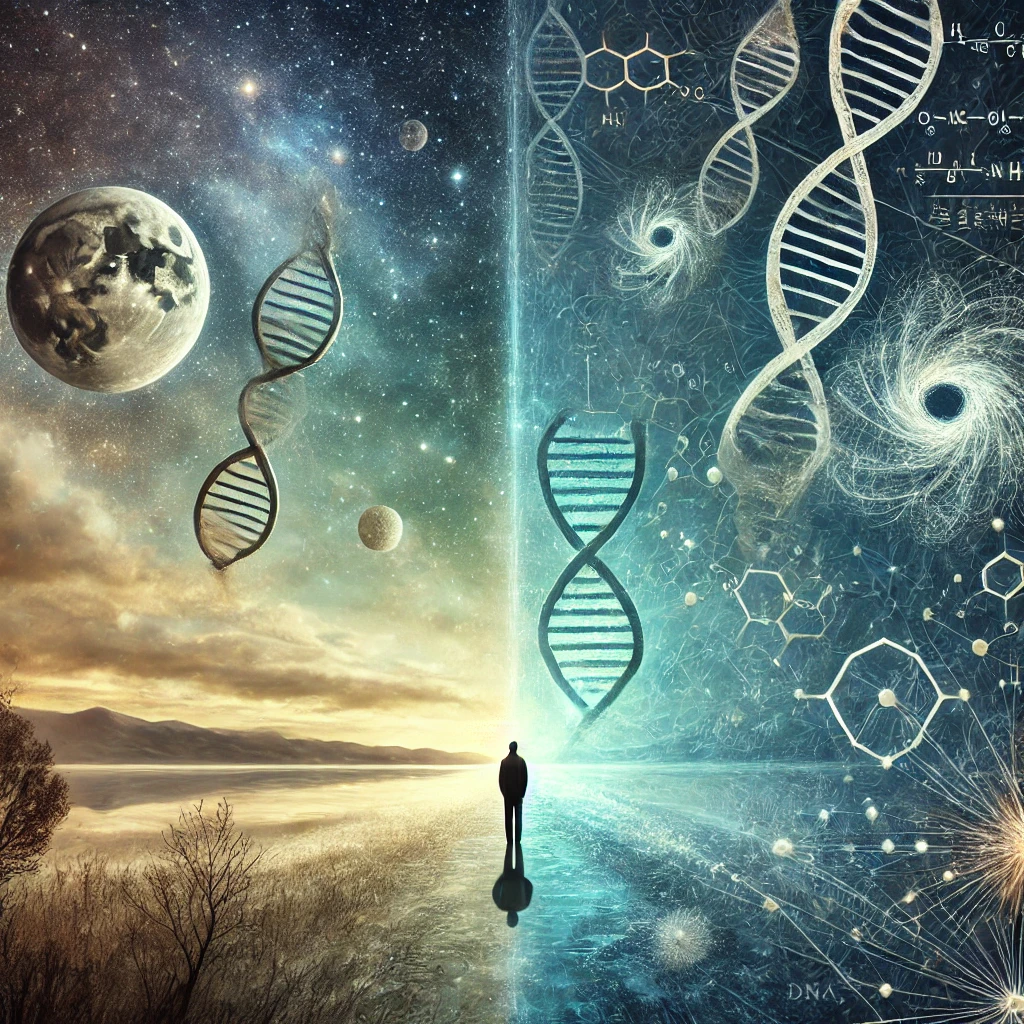
Having grown up within a Roman Catholic family, I was immersed in the religious rites. I was an altar boy, attended Mass on Sundays, and received the sacrament of Confirmation. But as the years went by, I became more interested in the scientific explanation of things than with customary belief. There is elegance in the accuracy of science, the rationality that assures us knowledge of how things operate—from the universe’s dimensions to how our own bodies work. And yet, for all science informs us about, there are holes, questions that are too big for any field to answer.
Science tells us much about the universe and how it came to be, but it never tells us why it exists in any way. Physicist Stephen Hawking has said, “One can’t prove that God doesn’t exist, but science makes God unnecessary.” It’s a line of thought which views the tension many feel between scientific knowledge and a creator. The concept of a “first mover,” some power or being that started the universe, is still out there. Science can map the ‘how,’ but for a lot of people, it leaves the ‘why’ dangling as an open question. And in those areas where it isn’t defined, there’s room for personal interpretation—spiritual, philosophical, or otherwise. In one’s own home, that ambiguity is palpable.
Living with the wake of PTSD and seeing friends die from suicide has made me confront life’s worst. Trauma reorients your thinking; it makes suffering and loss intelligible and is impatient with platitudes regarding purpose or destiny. Having seen up close the toll of inner war, platitudes like “never mind, everything happens for a reason” sound phony. The data on whether PTSD exists compels you to look for an explanation based on psychology, neuroscience, and the material means we have at hand to heal the hurting. While religion consoles you, with me, science is another sort of consolation. While previously I thought to turn to religion in an attempt to understand pain, now I turn to that comfort which I can see and comprehend.
Theory of psychology explains trauma as conditioned response—a survival mechanism out of whack that gets stuck. Neuroscience interprets the manner in which trauma reconditions the brain, offering a material context for understanding of an intensely painful experience. Grants from the National Institute of Mental Health (NIMH) and research by experts in trauma, i.e., Dr. Bessel van der Kolk, one of the authors of The Body Keeps the Score, turns PTSD’s underlying intricate biology into something actionable and real. For me, the process of making peace with trauma and loss isn’t about searching for cosmic reasons or divine answers; it’s about understanding the mechanics of pain and finding ways to live with it. Science, psychology, and the support of those who understand what it means to carry these burdens offer real, practical pathways forward. At the same time, I’m not closed off to the unknown.
I recognize the potential that there exist processes or powers that are outside our capacity to understand, possibly ever.
The science mysteries left unsolved do not drive me toward conventional faith but certainly make me open to the suggestion that there is something more. I don’t need a creed in order to empower these mysteries. They are what they are, mysteries on the edge of what we can know. And that is enough. The intersection of what I know and what I don’t make a place for science and religion in the unknown to live side by side without strife. Ultimately, I don’t need religion to mean something, nor do I need to eradicate it. I can accept the conflict between material and inexplicable, comforted by the response of science and the recognition that some things maybe never are going to be fully understood.
This is the perspective I’ve arrived at by experience and reflection, one which recognizes what we do know and the remaining unknown—without one answer being asked to hold everything together.